Three weeks of this life and I am peacing out to Korea. About ten years ago we flew halfway around the world on Baby M's birthday. He ended up having two birthdays and got to pick out chocolates on our flight. Then we learned English. Then we ate too many Cheetos and began the life cycle of American-style over-consumption.
About my break home-home: I asked my dad if I could visit another neighbor country up north (you know the one) and he said "NO!". So what can I do? I could learn how to roller blade. Travel around. Learn Korean fan dance. What do you do when you have nothing to do?
This weekend my task was to come up with the answer to this question: What would I do if I had $965 million dollars? My initial answer was: pay for dental school, of course! But wait, really?
Would I still become a dentist if I had enough money to do whatever the heck I wanted? If I was set for life financially? There has to be something else I want to do. Travel and see beautiful scenery. Swim all day in my private pool. Go to auctions to bid on all my favorite Matisse pieces. But at the end of the day, I could never "just" do this. My answer remains the same: with that $965 million dollars, I would pay my dental school tuition. Actually make that my entire classmates' tuition. The rest? I'd probably give it away to everyone I care about (this includes you if you are reading this).
This realization made me unbelievably happy. No matter what my circumstances are, I would still go to dental school and pursue what I'm pursuing now. I can't imagine doing anything else for the next four years.
Showing posts with label inspiration. Show all posts
Tuesday, May 8, 2012
Friday, April 13, 2012
Drinking out of a fire hydrant: Global Warming & Civic Scientists
I attended our weekly departmental lecture Thursday by Dr. John Anderson on global warming. He has been in the news lately about his censored article on Galveston. Heading down, I asked my friend, "Is this going to be really technical?" Because I get lecture abstracts from the listserve emails and don't know half the words in them. It turned out not to be. The lecture is part of Rice's UnConvention weekend and many in the audience were community members.
Some thoughts from the lecture:
- Can scientists be too "alarmist"? Dr. Anderson noted that now they are "vulgar" and throwing out phrases like "sea level rise", when decades ago they trotted carefully around the issue. Not to offend anyone.
- Free floating icebergs melting do not contribute to sea level rise!
- Most of sea level rise comes from thermal expansion of water!!!
- Glaciers don't grow back. Glaciers melting is inevitable. (I mean, obviously so but I never stopped to think about it.)
- How do we implement long-term changes that outlive politicians' election cycles???
After an hour of work catch-up, I made it to the Civic Scientist Lecture Series at the Baker Institute. I went to one by the discoverers of Buckyball a few years a back and loved it, so I RSVP'd for this one and invited a friend. The speakers were Dr. David Baltimore, 1975 Nobel Laureate in Physiology or Medicine, and Dr. Alice Huang, a Senior Faculty Associate in biology at Caltech.
It's hard to summarize their accomplishments into one line. But their achievements could go for hours.
Interesting points from this Civic Scientist talk:
- Average age of NIH grant recipients is 42. Much of great science accomplishments happen much younger.
- Why do we train foreigners? (I had never thought about this question...) Because in doing so, we are creating competition. But sometimes they stay in the U.S. and further American progress. (????)
- Wealthy individuals privately funding research is an American phenomenon. Howard Hughes of HHMI dropped out of Rice!!!!
- New Asia might be a good incubator for new scientists because traditionally people hold respect for intellectual pursuits. (Traditional Korean aristocrats called yang-ban's spent their days writing and reading!)
- "Is winning the Nobel Prize awesome?" Dr. Baltimore answered yes, because it is recognized by everyone. "But", he noted, "individuals being singled out for achievements is difficult."
- Scientists should become actively involved in policy making.
I had so many ideas during these lectures (thus the post title). Still organizing my notes from the talks. I love lectures that become a two-way conversation of sorts, where the ideas presented spark new ideas of my own. Much more excited about my career: scientists are not just scientists. We have a responsibility to spread our knowledge and influence policies.
Baker Institute had a fantabulous reception afterwards too. Munched on mini cheesecakes and chocolate-dipped strawberries while chatting with others who'd attended the conference. It's really interesting to hear what different people take away from the same lecture.
Some thoughts from the lecture:
- Can scientists be too "alarmist"? Dr. Anderson noted that now they are "vulgar" and throwing out phrases like "sea level rise", when decades ago they trotted carefully around the issue. Not to offend anyone.
- Free floating icebergs melting do not contribute to sea level rise!
- Most of sea level rise comes from thermal expansion of water!!!
- Glaciers don't grow back. Glaciers melting is inevitable. (I mean, obviously so but I never stopped to think about it.)
- How do we implement long-term changes that outlive politicians' election cycles???
After an hour of work catch-up, I made it to the Civic Scientist Lecture Series at the Baker Institute. I went to one by the discoverers of Buckyball a few years a back and loved it, so I RSVP'd for this one and invited a friend. The speakers were Dr. David Baltimore, 1975 Nobel Laureate in Physiology or Medicine, and Dr. Alice Huang, a Senior Faculty Associate in biology at Caltech.
It's hard to summarize their accomplishments into one line. But their achievements could go for hours.
Interesting points from this Civic Scientist talk:
- Average age of NIH grant recipients is 42. Much of great science accomplishments happen much younger.
- Why do we train foreigners? (I had never thought about this question...) Because in doing so, we are creating competition. But sometimes they stay in the U.S. and further American progress. (????)
- Wealthy individuals privately funding research is an American phenomenon. Howard Hughes of HHMI dropped out of Rice!!!!
- New Asia might be a good incubator for new scientists because traditionally people hold respect for intellectual pursuits. (Traditional Korean aristocrats called yang-ban's spent their days writing and reading!)
- "Is winning the Nobel Prize awesome?" Dr. Baltimore answered yes, because it is recognized by everyone. "But", he noted, "individuals being singled out for achievements is difficult."
- Scientists should become actively involved in policy making.
I had so many ideas during these lectures (thus the post title). Still organizing my notes from the talks. I love lectures that become a two-way conversation of sorts, where the ideas presented spark new ideas of my own. Much more excited about my career: scientists are not just scientists. We have a responsibility to spread our knowledge and influence policies.
Baker Institute had a fantabulous reception afterwards too. Munched on mini cheesecakes and chocolate-dipped strawberries while chatting with others who'd attended the conference. It's really interesting to hear what different people take away from the same lecture.
Labels:
biology+science,
current news,
inspiration,
social issues
Monday, March 26, 2012
Love this book: the perks of being a wallflower.
This is the first book I wished I had written.
I read this on the exercise bike sweating drops onto the pages and gosh this is the most wonderful piece of literature I have read. Because the character Charlie is so honest and feels everything and says things like this:
I didn't feel like reading that night, so I went downstairs and watched a half-hour-long commercial that advertised an exercise machine. They kept flashing a 1-800 number, so I called it. The woman who picked up the other end of the phone was named Michelle. And I told Michelle that I was a kid and did not need an exercise machine, but I hoped she was having a good night.And I am at peace with the ending. Somewhat unexpected but I think it explains a lot about Charlie. Charlie on the significance of your own problems:
That's when Michelle hung up on me. And I didn't mind a bit.
I think that if I ever have kids, and they are upset, I won't tell them that people are starving in China... because it wouldn't change the fact that they were upset. And even if somebody else has it much worse, that doesn't really change the fact that you have what you have. Good and bad... It's just different. Maybe it's good to put things in perspective, but sometimes, I think that the only perspective is to really be there. Like Sam said. Because it's okay to feel things. And be who you are about them.And it's now a movie!
![]() |
| Picture Source |
Sunday, February 26, 2012
TED: Schulz talks regret.
An hour until babysitting and this is exactly what I needed: Kathryn Schulz whose other talk I adored so much discusses regret.
![]() |
| 17 minutes. "Don't regret regret". |
Schulz discusses regret as it applies to different components of life, quoting the Roese and Summerville paper I found so fascinating. Here's the bottom line: I had focused more on minimizing regret by using the emotion as a preventative measure (will I feel regret in the future?). But listen:
Because the inability to experience regret is actually one of the diagnostic characteristics of sociopaths. It's also, by the way, a characteristic of certain kinds of brain damage... So if, in fact, you want to live a life free of regret, there is an option open to you. It's called a lobotomy. But if you want to be fully functional and fully human and fully humane, I think you need to learn to live, not without regret, but with it.
She discusses three ways to deal with regret once you feel you've made a dumb decision:
And the first of these is to take some comfort in its universality. If you Google regret and tattoo, you will get 11.5 million hits.
The second way that we can help make our peace with regret is to laugh at ourselves. All of us who've experienced regret that contains real pain and real grief understand that humor and even black humor plays a crucial role in helping us survive. It connects the poles of our lives back together, the positive and the negative, and it sends a little current of life back into us.
I love that last line.
The third way that I think we can help make our peace with regret is through the passage of time...
But what may be a really important lesson to learn(in a "hate the game, not the player"-esque fashion):
Here's the thing, if we have goals and dreams, and we want to do our best, and if we love people and we don't want to hurt them or lose them, we should feel pain when things go wrong. The point isn't to live without any regrets. The point is to not hate ourselves for having them.This brings us back to remembering to forgive yourself and move on after a mistake, even though the experience pains us. I have basically Ctrl+C/V'd the entire transcript here, so go ahead and listen to it. If you are a twenty-something on major career crossroads, it will speak to you.
Sunday, February 12, 2012
women in leadership.
I attended the 12th Annual Women in Leadership Conference at the Jones Business School this Friday. I was inspired by the strong women who were navigating these paths not only for themselves but for the women after them. In addition to the speakers and panelists, I met many empowered women who gave me advice and encouragement to lead a balanced, worthwhile and happy life. Couple of practical tips that resonated with me:
1. Negotiate your pay on your first job and every job that follows. (Women's pay gap widens from 6.5k at entry to 31k at executive levels.)
2. Find good sponsors at several steps above you. And become a sponsor for someone else.
From Martha Feeback of Catalyst
3. Take lateral moves if there are no promotion opportunities available.
4. If you can't participate in an event at the moment, tell them to ask again next week. (In male-dominated industries, sometimes you don't want to show your vulnerable side when/if asked to join in on golf, shooting, hunting.)
From Joan T. Eischen, author of Energy and the City
5. "The earth is but one country, and mankind its citizens." Home is anywhere you go.
6. Don't limit yourself. Look around. Remember this quote by Robert Browning: "Ah, but a man's reach should exceed his grasp. Or what's a heaven for?"
7. Remember that regardless of your chosen career, the world needs public service.
8. You are not alone in your endeavors. Consider the "unseen hands". Believe in the power of prayer.
From Ambassador Cynthia Shepard Perry
This conference came at a perfect time in my life when I was able to take these advice to heart. This and a ridiculously funny department banquet, and an evening discussing languages and literature back in the college dorm.
1. Negotiate your pay on your first job and every job that follows. (Women's pay gap widens from 6.5k at entry to 31k at executive levels.)
2. Find good sponsors at several steps above you. And become a sponsor for someone else.
From Martha Feeback of Catalyst
![]() |
| A rainy Friday |
4. If you can't participate in an event at the moment, tell them to ask again next week. (In male-dominated industries, sometimes you don't want to show your vulnerable side when/if asked to join in on golf, shooting, hunting.)
From Joan T. Eischen, author of Energy and the City
5. "The earth is but one country, and mankind its citizens." Home is anywhere you go.
6. Don't limit yourself. Look around. Remember this quote by Robert Browning: "Ah, but a man's reach should exceed his grasp. Or what's a heaven for?"
7. Remember that regardless of your chosen career, the world needs public service.
8. You are not alone in your endeavors. Consider the "unseen hands". Believe in the power of prayer.
From Ambassador Cynthia Shepard Perry
![]() |
| Love this notepad: better than "Keep Calm and Eat Cupcakes" |
Friday, December 23, 2011
research and expectations
A conversation with my co-worker F about research life made me think about expectations. We were preparing our next batch of samples, and we chatted about his decision to attend graduate school (after a short career of rock and roll) and mine not to.
Since I'd heard that first year of graduate school is often the hardest, I asked F how his year was going. "Great", he said, noting that something that keeps him going is high morale. "Do you know who Max Perutz is?" Max Perutz was an organic chemist who won the Nobel Prize in Chemistry in 1962 for his work on hemoglobin. If you've taken Biochemistry, you know how tricky (and amazing) this globular protein is. It has four subunits with Fe in the center heme group, and changes its structure when oxygen binds to facilitates the binding of the next oxygen.
Max Perutz spent years trying to determine the structure of this elusive protein. Because hemoglobin has a different structure when oxygen is bound to it, he would crystallize the protein in an anaerobic chamber (for X-ray crystallography) and oxygen would get in, alter its structure. "But", continued F, "instead of thinking he'd fail again, every day he came in thinking today would be the day he'd crystallize hemoglobin' ". And that he did.
This reminded me of another story from my Seattle friend when he was trying to crystallize a protein. Didn't work, kept going at it with tweaked conditions: pH, different substrates, everything and anything for months. I prodded on, "and?", waiting a grand finale of his finally crystallizing that bad boy. "And they canceled the project, and I stopped working in the lab". Hmm.
Pick your attitude. Do you: "Hope for the best" OR "Prepare for the worst."?
(because can you really do both full-heartedly?)
To summarize, people have low expectations because:
1) If the outcome is bad, they don't want to be disappointed.
2) If the outcome is good, they want to be pleasantly surprised.
But this study found that the subjects felt the same joy or disappointment regardless of their expectations, implying their expectations only affected their happiness during the waiting period.
![]() |
| Structure of Hemoglobin Picture |
Since I'd heard that first year of graduate school is often the hardest, I asked F how his year was going. "Great", he said, noting that something that keeps him going is high morale. "Do you know who Max Perutz is?" Max Perutz was an organic chemist who won the Nobel Prize in Chemistry in 1962 for his work on hemoglobin. If you've taken Biochemistry, you know how tricky (and amazing) this globular protein is. It has four subunits with Fe in the center heme group, and changes its structure when oxygen binds to facilitates the binding of the next oxygen.
Max Perutz spent years trying to determine the structure of this elusive protein. Because hemoglobin has a different structure when oxygen is bound to it, he would crystallize the protein in an anaerobic chamber (for X-ray crystallography) and oxygen would get in, alter its structure. "But", continued F, "instead of thinking he'd fail again, every day he came in thinking today would be the day he'd crystallize hemoglobin' ". And that he did.
This reminded me of another story from my Seattle friend when he was trying to crystallize a protein. Didn't work, kept going at it with tweaked conditions: pH, different substrates, everything and anything for months. I prodded on, "and?", waiting a grand finale of his finally crystallizing that bad boy. "And they canceled the project, and I stopped working in the lab". Hmm.
Pick your attitude. Do you: "Hope for the best" OR "Prepare for the worst."?
(because can you really do both full-heartedly?)
Blessed is he who expects nothing, for he shall never be disappointed. -Alexander Pope, 1688–1744
OR
This 2009 study by Golub, Gilbert and Wilson suggests that having low expectations may make you more unhappy than having high expectations, mostly because you make yourself unhappy during the waiting period before you know the actual outcome. If you harbor positive expectations, you can "savor" your daydreams and achievements before you find out the real result, compared to feeling "dread" if you expected the opposite.
1) If the outcome is bad, they don't want to be disappointed.
2) If the outcome is good, they want to be pleasantly surprised.
But this study found that the subjects felt the same joy or disappointment regardless of their expectations, implying their expectations only affected their happiness during the waiting period.
Tuesday, November 8, 2011
living with(out) regrets.
My day started off on an interesting note. Since I woke up early, I spent a leisurely morning on Google looking up "life's biggest regret's". Recently I have been nursing mixed feelings about a BIG decision I made couple of years ago, and on this particular morning I was in a state of regret. Did I make the right decision? Where would I be if I'd taken the other road? Had I been blinded by pride?
Needless to say, that lemon tart pie has left the bakery. But I also began to think about the emotion regret. There is a sense of defeat associated with feeling regret, and often people will deny feeling this forbidden emotion. But let's be honest for a minute: What do you regret in your life? What do you wish you could have done differently in your past?
A 2005 study by Roese and Summerville evaluated Americans' biggest life regrets by looking at nine articles studying regret and organizing the answers from 3,041 participants into six major categories. Biggest percentage of people expressed regrets on decisions they made on education.
I laughed out loud when I saw the examples- look at #1! The paper suggested that education may be the biggest life regret in this study for Americans because 1) education is widely available (university, professional schools, associate degrees, leisure learning classes) and 2) education opens the door to other possible desirable outcomes which may further be a source of regret ("I would've had a different job if I'd graduated").
Also fascinating was the Zeigarnik effect: "Regrettable failures to act tend to be more memorable and enduring than regrettable actions."(Gilovich and Medvec 1995) When asked "what they'd do differently", most people answer they should have done X, rather than that they should not have done Y. You can probably imagine thousand scenarios for what would have happened if you'd done something (picture a tree sprouting hundred branches) as opposed to reality where the possibility did not happen at all.
I haven't lived enough to feel regret to soak my dinner bread with tears, but should I be so worried about regretting a decision that I am terrified to make a move? Nah. But rather than declaring yourself immune to regret, I think it's important to recognize why you may be feeling regret: for me, I wonder if I'd spent enough time pondering the implications of my decision before I made it, if I gave my alternative a fair chance. So lesson learned, moving on and living in the now (especially since the past does not exist anyway).
Needless to say, that lemon tart pie has left the bakery. But I also began to think about the emotion regret. There is a sense of defeat associated with feeling regret, and often people will deny feeling this forbidden emotion. But let's be honest for a minute: What do you regret in your life? What do you wish you could have done differently in your past?
A 2005 study by Roese and Summerville evaluated Americans' biggest life regrets by looking at nine articles studying regret and organizing the answers from 3,041 participants into six major categories. Biggest percentage of people expressed regrets on decisions they made on education.
![]() |
| Biggest life regret by far: education |
- Career: jobs, employment, earning a living (e.g., “If only I were a dentist”)
- Community: volunteer work, political activism (e.g., “I should have volunteered more”)
- Education: school, studying, getting good grades (e.g., “If only I had studied harder in college”)
- Parenting: interactions with offspring (e.g., “If only I’d spent more time with my kids”)
- Family: interactions with parents and siblings (e.g., “I wish I’d called my mom more often”)
- Finance: decisions about money (e.g., “I wish I’d never invested in Enron”)
- Friends: interactions with close others (e.g., “I shouldn’t have told Susan that she’d gained weight”)
I laughed out loud when I saw the examples- look at #1! The paper suggested that education may be the biggest life regret in this study for Americans because 1) education is widely available (university, professional schools, associate degrees, leisure learning classes) and 2) education opens the door to other possible desirable outcomes which may further be a source of regret ("I would've had a different job if I'd graduated").
Also fascinating was the Zeigarnik effect: "Regrettable failures to act tend to be more memorable and enduring than regrettable actions."(Gilovich and Medvec 1995) When asked "what they'd do differently", most people answer they should have done X, rather than that they should not have done Y. You can probably imagine thousand scenarios for what would have happened if you'd done something (picture a tree sprouting hundred branches) as opposed to reality where the possibility did not happen at all.
![]() |
| xkcd.com knows regret |
I haven't lived enough to feel regret to soak my dinner bread with tears, but should I be so worried about regretting a decision that I am terrified to make a move? Nah. But rather than declaring yourself immune to regret, I think it's important to recognize why you may be feeling regret: for me, I wonder if I'd spent enough time pondering the implications of my decision before I made it, if I gave my alternative a fair chance. So lesson learned, moving on and living in the now (especially since the past does not exist anyway).
Friday, September 2, 2011
Forget about it, move on!
I had the most inspiring conversation with a guy who drove me from the car repair shop. I sometimes dread inevitable conversations with strangers because they feel forced and every silence turns into a frantic search for another topic, but we actually had a good conversation. His advice: “you’re young, you’re intelligent. Deal with it, just forget it happened, and move on. Don’t let this cripple you for the rest of your life!”. He was referring to my last rental car traumatic experience, but the way he said it, I imagined he would have said the same to me about other life happenings.
Saturday, July 9, 2011
accidental pizza (and how to love).
Times flies when you are having good conversation, and I am now way past my bedtime. T came over with her extra brownie mixes, so we mixed-baked-ate brownies while chatting on my kitchen floor. I hustled in from yoga fifteen minutes before she was scheduled to drop in, so I made this quick meal to throw in the oven while showering:
Tortilla eggplant-spinach pizza
Throw on spinach and eggplant(semi-cooked by throwing them in boiling water for ten seconds), dash of cilantro, and chopped onions on a whole wheat tortilla. Cook in oven for fifteen minutes at 350F- this makes the tortilla crusty while cooking the veggies entirely. When T calls for entrance to the gate, add mozzarella cheese and tomato sauce on top and heat in the microwave for two minutes. Run downstairs then bring your guest up to your apartment. And voila- the microwave rings and your pizzas are ready. Enjoy the cheesy-crusty-concoction so much you forget to snap pictures.
One of my favorite things T said in our conversation was an advice she once received: love someone so that they feel loved. It reminds me of two things: 1) Make it love, not an obsession or a disease, but something they welcome and want too. 2) If you love someone, let them know about it.
And so it goes.
Tortilla eggplant-spinach pizza
Throw on spinach and eggplant(semi-cooked by throwing them in boiling water for ten seconds), dash of cilantro, and chopped onions on a whole wheat tortilla. Cook in oven for fifteen minutes at 350F- this makes the tortilla crusty while cooking the veggies entirely. When T calls for entrance to the gate, add mozzarella cheese and tomato sauce on top and heat in the microwave for two minutes. Run downstairs then bring your guest up to your apartment. And voila- the microwave rings and your pizzas are ready. Enjoy the cheesy-crusty-concoction so much you forget to snap pictures.
![]() |
| I think I'll be dreaming about you... |
And so it goes.
Tuesday, July 5, 2011
what are we so afraid of?
I spent a good chunk of my Fourth of July re-organizing my apartment and creating a working nook space by a window. I also spent some time thinking about my career and my life trajectories, including the fact that by this time next year, I may be anywhere.
This is both exciting and scary, because I view life as a series of narrowing and delving process where with each decision we make we zoom in on a field, effectively eliminating the other possibilities out there. What if I take a wrong turn? What if I don't feel the same way twenty years down the road? What if they are right?
I watched this video from a recent TED conference by Kathryn Schulz. More than just a "wrongologist", she is a journalist and a writer whose recent book is titled "Being Wrong: Adventures in the Margin of Error". Here she talks about our misguided sense of "wrongness"- we don't know what is feels like to be wrong, instead we know what it feels like to realize we are wrong.
Why we shouldn't focus on being right (besides that our "internal sense of rightness" can be flawed):
This is both exciting and scary, because I view life as a series of narrowing and delving process where with each decision we make we zoom in on a field, effectively eliminating the other possibilities out there. What if I take a wrong turn? What if I don't feel the same way twenty years down the road? What if they are right?
I watched this video from a recent TED conference by Kathryn Schulz. More than just a "wrongologist", she is a journalist and a writer whose recent book is titled "Being Wrong: Adventures in the Margin of Error". Here she talks about our misguided sense of "wrongness"- we don't know what is feels like to be wrong, instead we know what it feels like to realize we are wrong.
At TED2011, March 2011
Why we shouldn't focus on being right (besides that our "internal sense of rightness" can be flawed):
But to me, what's most baffling and most tragic about this is that it misses the whole point of being human. It's like we want to imagine that our minds are just these perfectly translucent windows and we just gaze out of them and describe the world as it unfolds. And we want everybody else to gaze out of the same window and see the exact same thing... The miracle of your mind isn't that you can see the world as it is. It's that you can see the world as it isn't.Reminding us that life is not predictable:
... our stories are like this[surprise endings] because our lives are like this. We think this one thing is going to happen and something else happens instead... For good and for ill, we generate these incredible stories about the world around us, and then the world turns around and astonishes us.I took the advice I wanted to from this video, but I imagine different people will learn different lessons from this lecture. I'm reminded that "being right" is a subjective quality that may change depending on the time and the situation. Even if a decision was indeed "right" at a certain point, the world may change, and if I had made the said decision solely to be right, that decision will no longer hold intrinsic value for me.
Monday, April 25, 2011
love the questions.
Twelve brownie points for guessing where this is! (but of course.)
"Be patient toward all that is unsolved in your heart. Try to love the questions themselves like locked rooms and like books that are written in a very foreign tongue. Do not now seek the answers, which cannot be given to you because you would not be able to live them. And the point is, to live everything. Live the questions now. Perhaps you will then gradually, without noticing it, live along some distant day into the answer." -Rainer Maria Rilke
Saturday, February 12, 2011
embrace vulnerability.
A friend in my acting class mentioned in passing a TED lecture on vulnerability. Now that my week is over, I have time to snuggle in my bed & watch this video, which was just fantastic.
Being vulnerable- it is not just a life mantra that makes life a little bit relaxed and easier. It will actually make you happier, whole-hearted, and embrace yourself as you are.
Dr. Brene Brown is a professor at our neighbor University of Houston, studying the delicate humans emotions of shame, human connections, and vulnerability. Here is her main message from her website:
In the TED lecture, she talks about what the people who had made connections with others and had a "strong sense of love and belonging" had in common. They felt they were worthy, even if they weren't perfect: they embraced vulnerability , exposing their imperfect selves, letting themselves be terrified, hurt, and betrayed. They didn't particularly enjoy the idea of vulnerability(who does really?), but they accepted it as part of life and simply integrated it into their view of themselves.
Don't be afraid to let yourself fall, searching for security and stability, because this is life, and this is us. We may not be perfect, and we may be hurt and ashamed, but as Dr. Brown emphasizes in her lecture, we are enough, and we're worthy of all these happy things in life- love, friends, sense of belonging. Let things happen, embrace them as part of life because no one is perfect & feel sadness, feel anger, and feel joy and love.
You can watch Dr. Brene Brown speak in this life-affirming lecture here: the best 20 minutes you'll spend for yourself. She's an extremely engaging speaker- funny and self-depreciating, and you'll walk away with an upgraded(ly) happy view on life.
Friday, January 21, 2011
instant forgiveness.
I'm taking an acting class this semester, and so far it's been fascinating. Every day I walk in not knowing just what to expect. We're learning body movements and getting to know the stage, and becoming (very) comfortable with each other. Yesterday we made a jungle gym with our bodies while our 6'4 professor climbed on top of us over to the other side. This was after we played a vigorous game of tag, so everyone was leaning on each other in a big sweaty hot pile.
We also played a game of passing a ball from person-to-person in a predetermined set pattern where we keep adding more balls so that there are several paths going on at once, and when there's 10~ balls for 20 people, it gets really confusing since every second, you're either catching OR throwing. Our professor Justin emphasized that in this game if you drop the ball or miss a throw, "you have to instantly forgive yourself". He noted that especially since you're part of this bigger game and indispensable, you can't feel embarrassed, become angry, or however you may react to this "failure". He mentioned that while performing, if you mess up, you are the only person who will ever know. Everyone else will have no clue until you show it by turning red in the face, apologizing, stopping to catch yourself etc.
Also because we're doing all these activities where we have to really be out there & make ourselves vulnerable, he reminded us that our mistakes are simply going to evaporate and be forgotten every time we make them. He said: you can't go, "oh my gosh, I am so embarrassed I did that, I can never see these people again, I'm going to drop this class and drop out of college..." See how ridiculous it sounds when you verbalize it? But that's how we think sometimes- that everyone is watching and judging and remembering all the little mistakes we make, but really?
Make mistakes, instantly forgive yourself.
In my yoga class, after a difficult pose where everyone is twisting their bodies and grunting, panting, our yoga instructor reminds us to "forget what just happened. Repeat on other side". She hinted that the key to being a yoga-master (there must be a better term) is to have a bad memory, and simply not remember how difficult something was last time you did it.
Of course, bigger mistakes may not be forgotten by yourself or others, but that's why we have(my friend actually gave me one of these long time ago):
Body washes that will wash away your sins for you.
Well, but seriously, forgiving yourself may be the hardest thing to do, but it's often the most important task. (See lessons in acting; yoga;)
Wednesday, October 13, 2010
Civic Scientists: little pieces of knowledge.
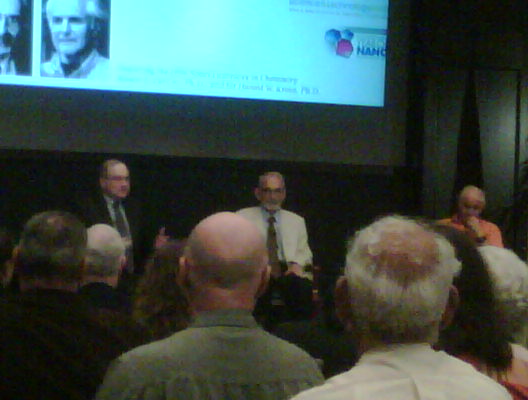
I attended an incredible talk by 1996 Nobel Laureates Dr. Robert Curl and Sir Harold Kroto this evening. Let me just read that sentence again and bathe in its glory. I was 30 feet away from not one, but two Nobel laureates. Wow. I was especially excited about this lecture which was part of the Civic Scientist lecture series.
A ‘civic scientist’ to me is a true scientist who uses his or her knowledge, accomplsihemnts, and analytical skills to help bridge the gap between science and society.” -Dr. Neal Lane.
Dr. Lane was actually the one who introduced our two speakers for the night!
Dr. Robert Curl came on the stage first to talk about the public opinion and science. He spoke about the fact that there is often public resistance to information that may be inconvenient, fearful, or contradictory to their beliefs. Well, many of the public debates involve questioning of science facts at heart. Abortion/stem cell research asks when a fetus is human, and global warming begins the issue with: is this even happening? It was especially interesting how he contributed the phenomenon of public ignorance to the development of internet. Simply due to the vast amount of information online, people can find others who agree with their views. It’s so easy.
Next, Sir Kroto, in a bright orange shirt, spoke more about the fundamental importance of science. Yes, it is useful because there are nurses who can’t use decimals and administer exponentially wrong amounts of medicine (eeek), ahd science may lead to development of the most gracious gift to humanity: anesthesiology.While we try to emphasize the importance of science by asserting its practicality and usefulness, science needs to be appreciated for its innate beauty (See Richard Feynman lectures).
Sir Kroto closed the talk with a clip from the movie “The Third Man”. Like Harry Lime, the truth is always true (duh) and constant. As Sir Kroto put it, it does not sway to people’s prayers. The truth may be hidden and elusive, and may lead to initial confusion, but it has always been there and it will always be there. It just hasn’t been fully understood, yet.
Dr. Lane, Dr. Curl, and Sir Kroto.
Again to the importance of civic scientists: scientists, as discoverers of natural facts, need to facilitate the public’s understanding of truths. The talk reminded me of the Newsweek article I read titled “Their Own Worst Enemies” by Sharon Bagley. She states that scientists expect the public to understand and absorb the facts they generate and throw out at them, whereas the public may feel insulted or ignored in response. Hmm.
I am undecided as to what kind of scientist I will be, but I would like to be a fundamentally, a civic scientist under all my titles. I want to take the kind of knowledge I have and use it to inform others who can then make truly informed decisions. Here’s the image I have: I’m a mom by the kitchen with a knife that only I can use (because I’m the grown up adult), who will cut up the pieces of chicken for the kids to eat. Because it’s unreasonable for me to expect the kids to chew and digest the huge pieces of meat, and I have the tool to make it edible for them, it is my responsibility to, naturally.
Saturday, February 13, 2010
Jill Bolte Taylor, on having a stroke
An instructor from a leadership class I'm taking sent us the link to this amazing video.
Jill Bolte Taylor, is a neuroanatomist who at age 37, had a massive stroke that took her 8 years to recover. I watched her TED Conference video, but she also has a bestselling book named "My Stroke of Insight: A Brain Scientist's Personal Journey".
Here is a quote from the talk, when Dr. Taylor talks about waking up the afternoon of the stroke:
"Because I could not identify the position of my body in space, I felt enormous and expansive, like a genie just liberated from her bottle. And my spirit soared free, like a great whale gliding through the sea of silent euphoria. Nirvana. I found Nirvana. And I remember thinking, there's no way I would ever be able to squeeze the enormousness of myself back into this tiny little body."
Watch it. These will be the best 20 minutes you spent of your day yet!
Jill Bolte Taylor, is a neuroanatomist who at age 37, had a massive stroke that took her 8 years to recover. I watched her TED Conference video, but she also has a bestselling book named "My Stroke of Insight: A Brain Scientist's Personal Journey".
Here is a quote from the talk, when Dr. Taylor talks about waking up the afternoon of the stroke:
"Because I could not identify the position of my body in space, I felt enormous and expansive, like a genie just liberated from her bottle. And my spirit soared free, like a great whale gliding through the sea of silent euphoria. Nirvana. I found Nirvana. And I remember thinking, there's no way I would ever be able to squeeze the enormousness of myself back into this tiny little body."
Here is the link on the TED website:
Watch it. These will be the best 20 minutes you spent of your day yet!
Subscribe to:
Posts (Atom)